
Harlequin Ichthyosis LMB
Harlequin ichthyosis (HI) is a rare skin condition. Infants with HI are born with their bodies covered in hard, thick skin that forms large diamond-shaped plates separated by deep cracks. HI is the most severe form of autosomal recessive congenital ichthyosis (ARCI).
Longterm Course
Key Findings
- Skin
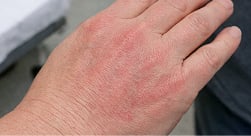
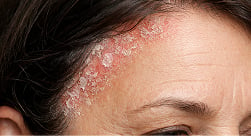
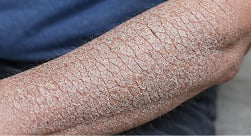
Generalized redness; thick, generally dark, scales that tend to form parallel rows of spines or ridges,especially near large joints; the skin is fragile and blisters easily following trauma; extent of blistering and amount of scale is variable. - Nails
Thickening or dystrophy of one or more nails (common) - Hair
Often sparse; no shaft abnormalities.
Associated Findings
- Usually none
Additional Resources
- Clinicians seeking to confirm a diagnosis should visit the Edvyce portal to submit a case to experts in ichthyosis.
- Learn more about FIRST’s Support Services – connecting affected individuals and families with each other. Or call the FIRST office at 800-545-3286.
- Information about current clinical trials and research studies can be found here.
- Improved Management of Harlequin Ichthyosis With Advances in Neonatal Intensive Care
Community Story
- Congenital Ichthyosiform Erythroderma (CIE)
- Lamellar Ichthyosis
- Collodion Baby
- Darier Disease
- Epidermal Nevus
- Epidermolytic Ichthyosis
- Erythrokeratodermia Variabilis
- Erythrokeratodermia Cardiomyopathy Syndrome
- Harlequin Ichthyosis
- Ichthyosis Vulgaris
- Ichthyosis with Confetti
- Keratitis-Ichthyosis-Deafness (KID)
- Netherton Syndrome
- Pachyonychia Congenita
- Palmoplantar Keratodermas
- Sjögren-Larsson Syndrome
- X-Linked Ichthyosis
- Chanarin Dorfman Syndrome
- CHILD Syndrome
- Conradi-Hünermann
- Ichthyosis Hystrix with Deafness (HID) Syndrome
- Ichthyosis Hystrix Curth-Macklin
- Refsum Disease
- Trichothiodystrophy
Phenotype Names
harlequin fetus
EDD Name
ABCA12-nEDD
OMIM
Inheritance
Autosomal recessive
Incidence
Very Rare
Diagnostic Tests
–
Age of First Appearance
Birth
Abnormal Gene
ABCA12
Primary Symptom Photos
What Causes Harlequin Ichthyosis?
For more information on the genetics of harlequin ichthyosis refer to FIRST’s publication, Ichthyosis: The Genetics of Its Inheritance.)
How common is it?
What are the Signs & Symptoms?
Other names you might hear it called:
- Autosomal recessive congenital ichthyosis (ARCI) – harlequin ichthyosis type
- Harlequin baby syndrome
- Harlequin fetus
- Eyelids that are turned inside out so that the eyes can’t close
- Lips that are pulled tight, so the mouth stays open; this makes it difficult for the baby to nurse or take a bottle
- A flat nose and ears that are fused to the head
- Small, swollen hands and feet
- Arms and legs with limited mobility
- Dry skin that easily becomes infected
- A lower-than-normal body temperature
- Eyelids that are turned inside out so that the eyes can’t close
- Lips that are pulled tight, so the mouth stays open; this makes it difficult for the baby to nurse or take a bottle
- A flat nose and ears that are fused to the head
- Small, swollen hands and feet
- Arms and legs with limited mobility
- Dry skin that easily becomes infected
- A lower-than-normal body temperature
Children with HI will likely have red, scaly skin throughout their lives. They may also have:
- Thin or fragile hair due to scales on the scalp
- Reduced hearing caused by scale buildup in the ears
- Thickened, discolored, or oddly shaped fingernails and toenails
- Difficulty moving hands, arms, feet and legs because of stiff, inflexible, sometimes painful joints
- Frequent skin infections
- Inability to sweat
What to Expect
- Physical growth and development may be delayed in children with HI. Mental development, however, should be normal.
- Every person’s experience with HI is unique. Many people may offer advice about skin care products and coping strategies that they have found helpful. Keep in mind that what has worked for someone else may or may not work for you/your child. You may need to try a variety of skin care products and approaches before finding tone that produces the best results for you/your child.
- It’s important to find a dermatologist that knows how to treat HI, especially as it is so rare.
- Developing a daily routine to help control skin scales, itching, and skin cracking is important.
- Thick fingers and stiff knuckles can make it difficult for people with HI to grip things with their hands, while stiff knees and ankles can limit walking.
Treatments & Self-Care
The main treatments for HI are
- Bathing or showering frequently using a mild, soap-free cleanser to soften the skin and remove layers of thickened skin
- Rubbing the skin lightly with a loofah, rough-textured sponge, or pumice stone to help remove thickened skin
- Applying moisturizers to the skin after bathing or showering and throughout the day to reduce skin dryness; be careful not to use perfumed lotions
- In the neonatal and infantile period, drugs called retinoids can be life-saving (see below)
EI may also be treated with drugs called retinoids. These drugs can reduce skin scaling, but if they are discontinued the scales come back. Long-term use of retinoids can cause serious adverse effects, so doctors prescribe them only when symptoms are very severe.
Oral retinoids, such as Etrenate, can be lifesaving for infants with severe HI manifestations. Oral retinoids may help to reverse issues such as: constricting fingers or even compromised blood flow, chest that is so tight there is trouble breathing, and/or face that is so tight the baby cannot feed. Oral retinoids are usually temporary and tapered off by 6 months. They can be considered in older children if helpful, but often are not needed because these skin changes at birth are not recurrent.
Things to Keep in Mind
- HI is a chronic condition that needs lifelong, daily, meticulous care.
- HI is not contagious. No one can catch it by touching or being close to you or to your child with EI.
- Both cold and hot weather present challenges for people with HI.
- In cold weather, the air is drier and the skin is likely to dry out and crack more easily. You may need to moisturize your skin even more frequently or use stronger moisturizing products.
- In hot weather your body will overheat very quickly because it can’t expel heat by sweating. To minimize overheating when outdoors, wear sun-protective clothing, apply sunscreen, and seek shade.
- People (some well meaning, others less so) may stare at you, or at your child with EI, and ask questions like “What’s wrong with your skin/your child?” or “Does it hurt?”.
- Other children may tease or bully your child with HI because of their appearance.
- Explaining to people that you, or your child who has HI, were born with the condition may help them understand that you’re not sick and that you live with the condition every day.
- When you have HI, your skin may look different from other people’s, but you can still do most things that other people do.
- You are not responsible for other people’s reactions to your or your child’s appearance. Your skin condition does not define who you are.
- Parents of a child with EI may feel a need to be very protective of them.
- Do your best to treat your child with EI in the same way as unaffected children in the family, while allowing for the fact that your child with EI needs a special skin care regimen and must take certain precautions (e.g., in hot or cold weather).
- For example, hold them to similar expectations and encourage them to follow their dreams and ambitions just as you do your other children.
- Reinforce in your child with HI that their skin condition does not define who they are or what they can achieve in their lives.
Questions to Ask
Sources
- Dahl AA. Ichthyosis Treatment & Management. 2018 Aug 28. https://emedicine.medscape.com/article/1198130- treatment#d2
- FIRST. Harlequin Ichthyosis: A Patient’s Perspective. https://www.firstskinfoundation.org/types-of-ichthyosis/harlequin-ichthyosis
- Healthline.com. A Parent’s Guide to Harlequin Ichthyosis. 2018 Dec 3. https://www.healthline.com/health/harlequin-ichthyosis
- Medline Plus Genetics. Harlequin ichthyosis. https://medlineplus.gov/genetics/condition/harlequin-ichthyosis/
- National Organization for Rare Disorders. Harlequin Ichthyosis. https://rarediseases.org/rare-diseases/ichthyosis-harlequin-type/
- To learn more about ichthyosis research or find out how you can partner with FIRST members on a research study, visit the current clinical trials and research studies section on FIRST’s website. »
- Clinicians seeking to confirm a diagnosis should visit FIRST’s TeleIchthyosis site to submit a case to experts in ichthyosis. »
- Learn more about FIRST’s Support Services – connecting affected individuals and families with each other. Or call the FIRST office at 800-545-3286.
- Visit EI Cure Project for additional information on epidermolytic ichthyosis
- Visit EI Cure Project for additional information on the care of newborns and infants with epidermolytic ichthyosis
Related Information

November 2013 Galderma Study, Lamellar Ichthyosis – A qualitative survey in the US and Europe.
November 2013 Galderma Study, Lamellar Ichthyosis – A qualitative survey in the US and Europe.
November 2013 Galderma Study, Lamellar Ichthyosis – A qualitative survey in the US and Europe.
November 2013 Galderma Study, Lamellar Ichthyosis – A qualitative survey in the US and Europe.