Collodion Baby
Not a disease itself but rather a presentation at birth where the infant is encased in a tight shiny membrane, representing the first expression of various forms of ichthyosis.
What is Collodion Baby?
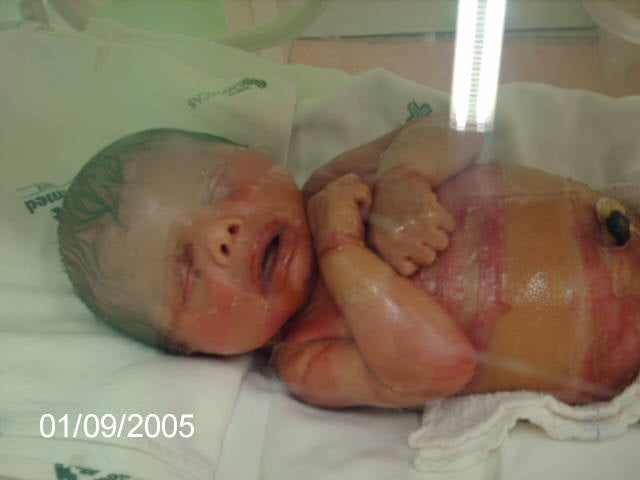
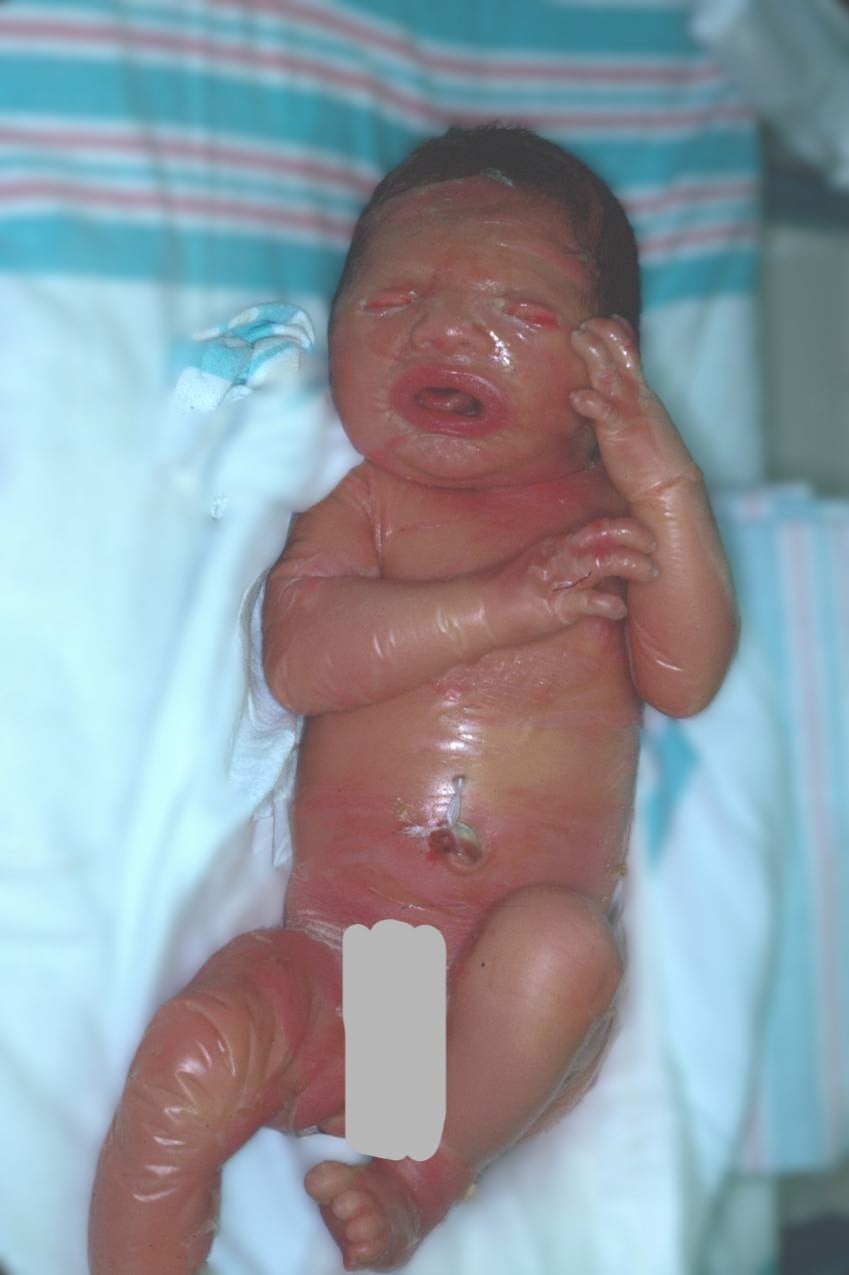
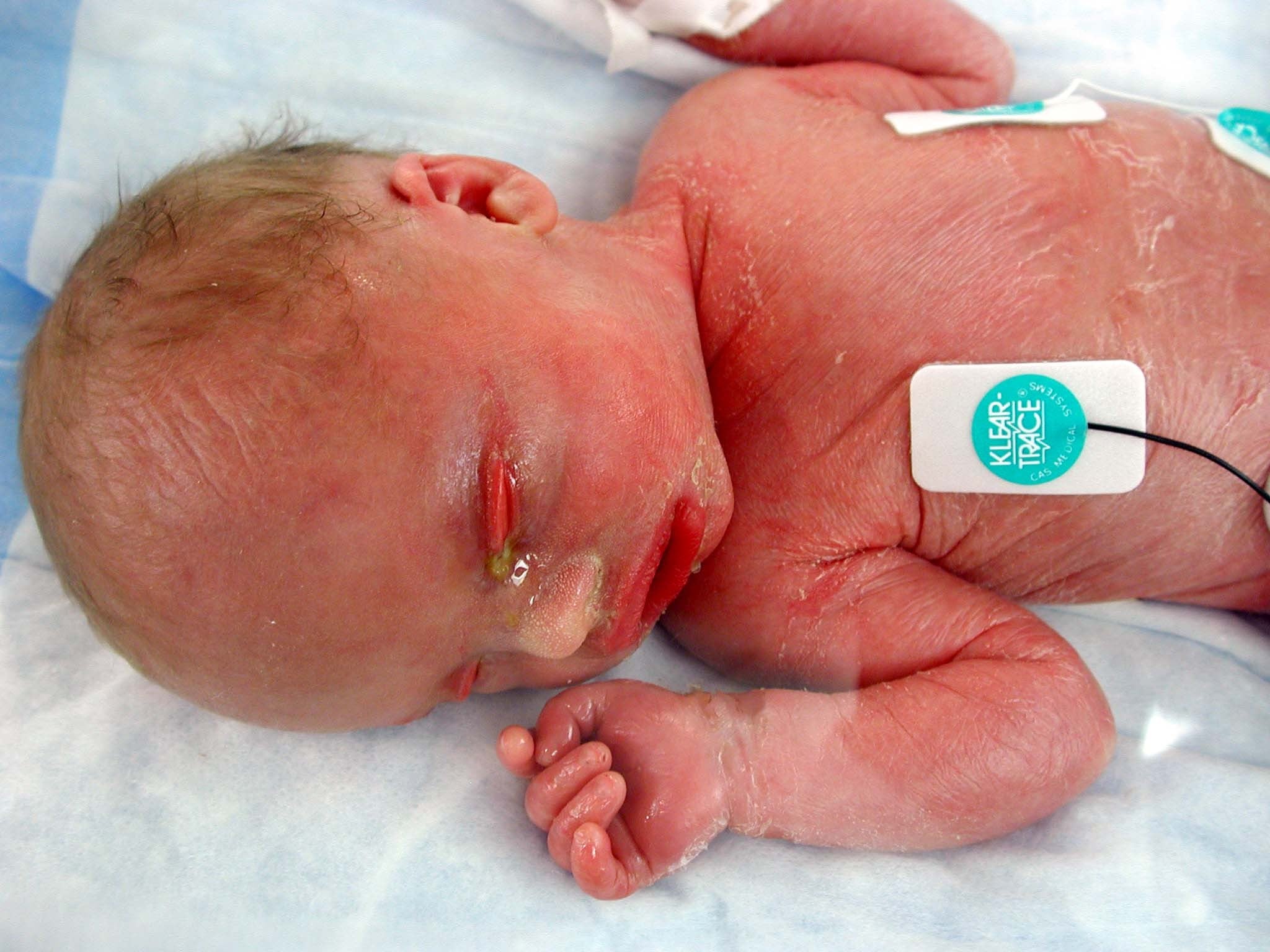
The collodion baby is a descriptive term for the infant who is born encased in a tight shiny membrane that resembles plastic wrap. The collodion baby is not a disease entity but is the first expression of some forms of ichthyosis.
Longterm Course
It depends on underlying cause; most individuals have lifelong lamellar ichthyosis or congenital ichthyosiform erythroderma; some shed the collodion membrane and have no skin or other sequelae; some have trichothiodystrophy, X-linked recessive, neutral lipid storage disease, or Gaucher’s disease.
Key Findings
- Skin
A parchment-like covering of the entire skin surface that cracks before or shortly after birth and then peels off in 2-4 weeks; eversion of eyelids (ectropion) and lips (eclabium) improves as collodion membrane shed
Associated Findings
- There may be none; depends on the skin type causing the collodion membrane.
Clinical Resources
- Clinicians seeking to confirm a diagnosis should visit the Edvyce portal to submit a case to experts in ichthyosis.
- Learn more about FIRST’s Resources for individuals and families affected by Ichthyosis
- Information about current clinical trials and research studies can be found here.

What are the Signs & Symptoms?
The collodion membrane cracks and peels over the course of several weeks. The tightness of the membrane may cause the eyelids to turn out revealing the pink inner lid; a condition called ectropion. Eclabium, the turning out of the lips due to the tightness of the membrane, may accompany the ectropion, and may cause difficulties with nursing. When the membrane is completely shed the infant may display one of several ichthyosis skin types. Congenital ichthyosiform erythroderma (CIE) and lamellar ichthyosis are the most commonly seen forms of ichthyosis presenting with a collodion membrane. However, the membrane may also be present in Netherton syndrome and other very rare forms of ichthyosis, and is always present with harlequin ichthyosis. A small percentage of infants shed the membrane and never display any other skin involvement; a phenomenon called “self-healing collodion baby.”
Collodion babies are at high risk of some complications. The cracking and peeling of the membrane increases the risk of infection from microorganisms. These infants are also at risk for fluid loss, dehydration, electrolyte imbalance, body temperature instability, and pneumonia.
Collodion babies are at high risk of some complications. The cracking and peeling of the membrane increases the risk of infection from microorganisms. These infants are also at risk for fluid loss, dehydration, electrolyte imbalance, body temperature instability, and pneumonia.
How is it Diagnosed?
There is currently no diagnostic test, it is generally determined by the presence of the encasement membrane. Again, the collodion baby is not a disease entity but is the first expression of some forms of ichthyosis.
Doctors frequently use genetic testing to help define which ichthyosis a person actually has. This may help them to treat and manage the patient. Another reason to have a genetic test is if you or a family member wants to have children. Genetic testing, which would ideally be performed first on the person with ichthyosis, is often helpful in determining a person’s, and their relative’s, chances to have a baby with ichthyosis. Genetic testing may be recommended if the inheritance pattern is unclear or if you or a family member is interested in reproductive options such as genetic diagnosis before implantation or prenatal diagnosis.
Results of genetic tests, even when they identify a specific mutation, can rarely tell how mild or how severe a condition will be in any particular individual. There may be a general presentation in a family or consistent findings for a particular diagnosis, but it’s important to know that every individual is different. The result of a genetic test may be “negative,” meaning no mutation was identified. This may help the doctor exclude certain diagnoses, although sometimes it can be unsatisfying to the patient. “Inconclusive” results occur occasionally, and this reflects the limitation in our knowledge and techniques for doing the test. But we can be optimistic about understanding more in the future, as science moves quickly and new discoveries are being made all the time. You can participate in research studies and also receive genetic testing through the National Ichthyosis Registry at Yale University or for more information about genetic tests performed you can visit GeneDx, www.genedx.com.
Doctors frequently use genetic testing to help define which ichthyosis a person actually has. This may help them to treat and manage the patient. Another reason to have a genetic test is if you or a family member wants to have children. Genetic testing, which would ideally be performed first on the person with ichthyosis, is often helpful in determining a person’s, and their relative’s, chances to have a baby with ichthyosis. Genetic testing may be recommended if the inheritance pattern is unclear or if you or a family member is interested in reproductive options such as genetic diagnosis before implantation or prenatal diagnosis.
Results of genetic tests, even when they identify a specific mutation, can rarely tell how mild or how severe a condition will be in any particular individual. There may be a general presentation in a family or consistent findings for a particular diagnosis, but it’s important to know that every individual is different. The result of a genetic test may be “negative,” meaning no mutation was identified. This may help the doctor exclude certain diagnoses, although sometimes it can be unsatisfying to the patient. “Inconclusive” results occur occasionally, and this reflects the limitation in our knowledge and techniques for doing the test. But we can be optimistic about understanding more in the future, as science moves quickly and new discoveries are being made all the time. You can participate in research studies and also receive genetic testing through the National Ichthyosis Registry at Yale University or for more information about genetic tests performed you can visit GeneDx, www.genedx.com.
What is the Treatment?
Collodion babies should be placed in a high humidity chamber, and monitored closely for complications. A high humidity environment will allow slow, gradual sloughing off of the membrane. The membrane will come off on its own and should not be peeled off. Application of mild petroleum-based moisturizers may help the infant feel more comfortable while the membrane is peeling off.
A consult with a pediatric dermatologist will be necessary to determine which form of ichthyosis is present, if any. (Contact FIRST for a referral to a dermatologist familiar with ichthyosis.)
A consult with a pediatric dermatologist will be necessary to determine which form of ichthyosis is present, if any. (Contact FIRST for a referral to a dermatologist familiar with ichthyosis.)
Types of Ichthyosis
- Congenital Ichthyosiform Erythroderma (CIE)
- Lamellar Ichthyosis
- Collodion Baby
- Darier Disease
- Epidermal Nevus
- Epidermolytic Ichthyosis
- Erythrokeratodermia Variabilis
- Erythrokeratodermia Cardiomyopathy Syndrome
- Harlequin Ichthyosis
- Ichthyosis Vulgaris
- Ichthyosis with Confetti
- Keratitis-Ichthyosis-Deafness (KID)
- Netherton Syndrome
- Pachyonychia Congenita
- Palmoplantar Keratodermas
- Sjögren-Larsson Syndrome
- X-Linked Ichthyosis
- Chanarin Dorfman Syndrome
- CHILD Syndrome
- Conradi-Hünermann
- Ichthyosis Hystrix with Deafness (HID) Syndrome
- Ichthyosis Hystrix Curth-Macklin
- Refsum Disease
- Trichothiodystrophy
Phenotype Names
Collodion Baby
EDD Names
Not a final diagnosis — a transient neonatal presentation. The underlying EDD is determined by which gene is affected.
OMIM
none
Inheritance
Variable
Incidence
Estimated at 1:100.000
Diagnostic Tests
none
Age of First Appearance
Birth
Abnormal Gene
Many
Primary Symptom Photos