
Understanding the biology of X-linked ichthyosis (XLI) and associated medical conditions with a new mouse model (2025)

William Davies, PhD
Reader Cardiff University Schools of Medicine and Psychology
Award: $50,000
To use a new mouse model to understand the biology of XLI and associated medical conditions. The proposed project has the potential to identify, for the first time, biological processes underlying conditions which have large effects on quality-of-life, morbidity and mortality in individuals affected by the second most common subtype of ichthyosis; this, in turn, may point to potential therapeutic targets in XLI which may be investigated in future work.
AIMS:
To breed and behaviourally-test adult wildtype (WT) and homozygous male mice (lacking the X-linked ichthyosis-associated protein steroid sulfatase (STS)
To compare gene expression between adult WT and homozygous male mice in three key tissues associated with XLI phenotypes: skin, brain and heart
To identify general, and tissue-specific, biological pathways perturbed in male mice lacking STS with a view to identifying novel therapeutic targets in XLI
METHODS:
We will breed and behaviourally-test wildtype (n=12) and homozygous (n=12) adult male mice lacking funcitonal STS protein (as a consequence of a 22 nucleotide frame-shifting deletion in critical exon 2), and, post mortem collect ear skin, brain region striatal), and whole heart tissues for RNA extraction. For the brain and heart samples, we will compare global gene expression in wildtype and mutant tissues via bulk RNASeq analysis using illumina sequencing with -70million raw reads per sample according to standard protocols. Using a combination of differential gene expression analysis (DESeq2) and Gene Ontology/Pathway software (e.g. DAVID) we will identify heart/brain gene expression differences/pathways that differ between the genotypes across both tissues, or in a tissue-specific manner. Selected gene expression differences will be followed up with immunohistochemistry in additional animals (n=6 per group). Using quantitative PCR, we will test whether gene expression differences observed in heart/brain are also seen in skin samples. Using a similar Sts-deletion mouse, colleagues in South Korea have recently identified gene pathways disturbed in the skin (doi:10.1016/j.bbadis.2023.167004) and we also aim to replicate these initial findings. The proposed study will allow us to prioritise causal mechanisms underlying serious XLI-associated phenotypes.
RELEVANCE TO THE MISSION OF FIRST:
In collaboration with FIRST and Ichthyosis Support Group UK, our research group have shown that XLI is associated with a substantially-increased risk of Attention Deficit Hyperactivity Disorder (ADHD)(affecting 30-40% of individuals)(doi:10.1371/journal.pone.0164417) which may be due to smaller volume of basal ganglia subregions (doi: 10.1136/jmedgenet-2019-106676). We have also shown that XLI is associated with a substantially-increased risk of heart arrhythmias (affecting 30-40% of individuals))(doi:10.1136/jmedgenet-2019-106676 and 10.1136/jmg-2022-108862) which confer significantly increased risk of heart failure, stroke and accelerated cognitive decline and which could predispose to Sudden Arrhythmic Death Syndrome
(SADS)(doi:10.14744/AnatolJCardiol.2025.4903). The planned work will identify biological pathways underlying these common and disabling comorbidities within XLI, and will indicate promising novel therapeutic targets.
Progress Report: October 2026
Original Aims
- Breed wildtype and STS-deficient adult male mice (n=12 per group)
- Following baseline weighing, water restriction, and milk preference test to assess motivation for reinforcer to be used in cognitive test, train and test mice on 5-choice serial reaction time task (5-CSRTT) to assess attention and impulsivity phenotypes
- Post cognitive testing, and ad libitum water, dissect relevant tissues: ear skin, whole heart, basal ganglia (brain)
- Extract RNA from tissues and perform expression analyses (RNASeq in heart and brain samples, quantitative PCR in skin samples)
- Identify gene expression differences between groups and overlap in these across tissues
- Examine spatial expression patterns of candidate genes across groups with histology
Progress to Date
Project began 1st April 2026, and has been running 7 months
- 18 wildtype and 15 STS-deficient adult male mice have been generated
- All mice have undergone baseline weighing, water restriction and milk preference test
- 10 mice (5 wildtype and 5 STS-deficient mice) have completed all manipulations on the 5-CSRTT, and their tissues have been collected for gene expression analysis; the remaining 23 mice are currently undergoing 5-CSRTT and should be finished by mid-Jan 2027.
- Gene expression and downstream analyses will be conducted mid-Jan 2027-end of March 2027.
Interim results
Baseline bodyweight
Prior to water restriction, mice were weighed for three consecutive days, and their mean bodyweight recorded. After covarying for age, there was no significant difference in bodyweight between wildtype and STS-deficient mice (estimated marginal means: 27.7±0.4g vs. 27.2±0.4g respectively, F[1,30]=0.73, p=0.40).
Milk preference test
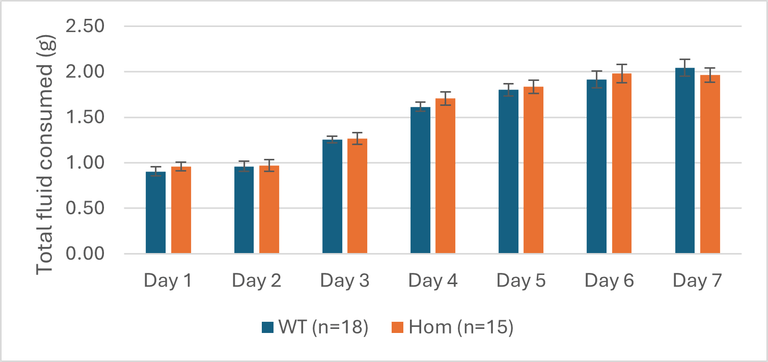
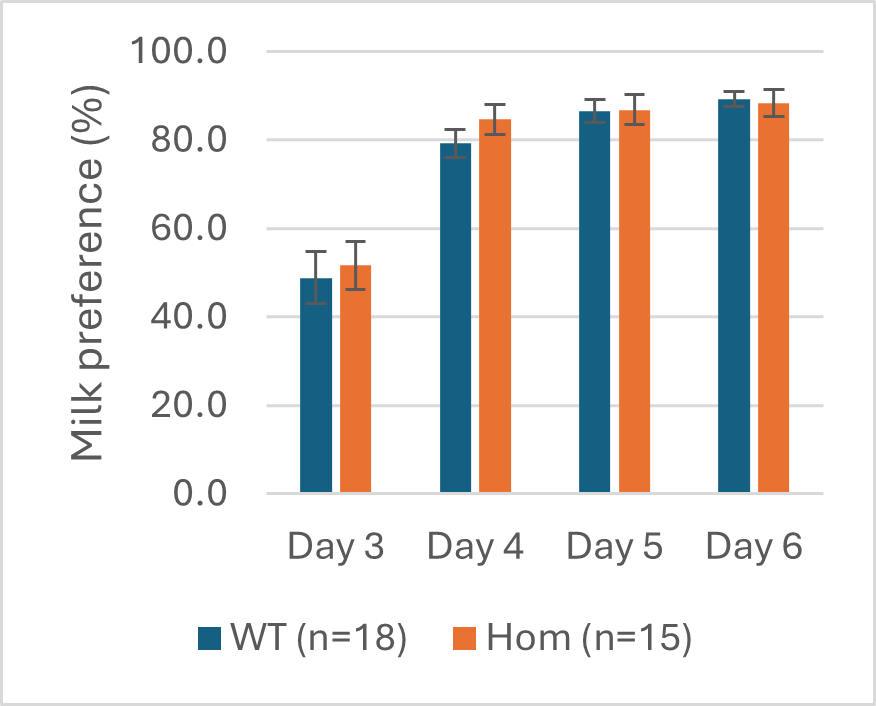
Following water restriction, mice were subject to a milk preference test to investigate their reactivity and habituation to a novel foodstuff (10% condensed milk solution) to be used as the reinforcer in the 5-CSRTT. On Days 1 and 2 of the test, mice were exposed to water only, on Days 3-6 they were given a choice of water or milk, and on Day 7, they were exposed to milk only. We saw the expected increase in overall fluid consumption across test days, with wildtype and STS-deficient mice drinking equivalent volumes of milk on Day 7 (>1.9ml on average, effect of genotype covarying for bodyweight0.75, F[1,30]=0.07, p=0.80). Wildtype and STS-deficient mice showed equivalent preference for milk vs. water on Day 6 (>85% on average, F[1,31]=0.07, p=0.79).
5-choice serial reaction time task
Training to baseline performance and baseline performance
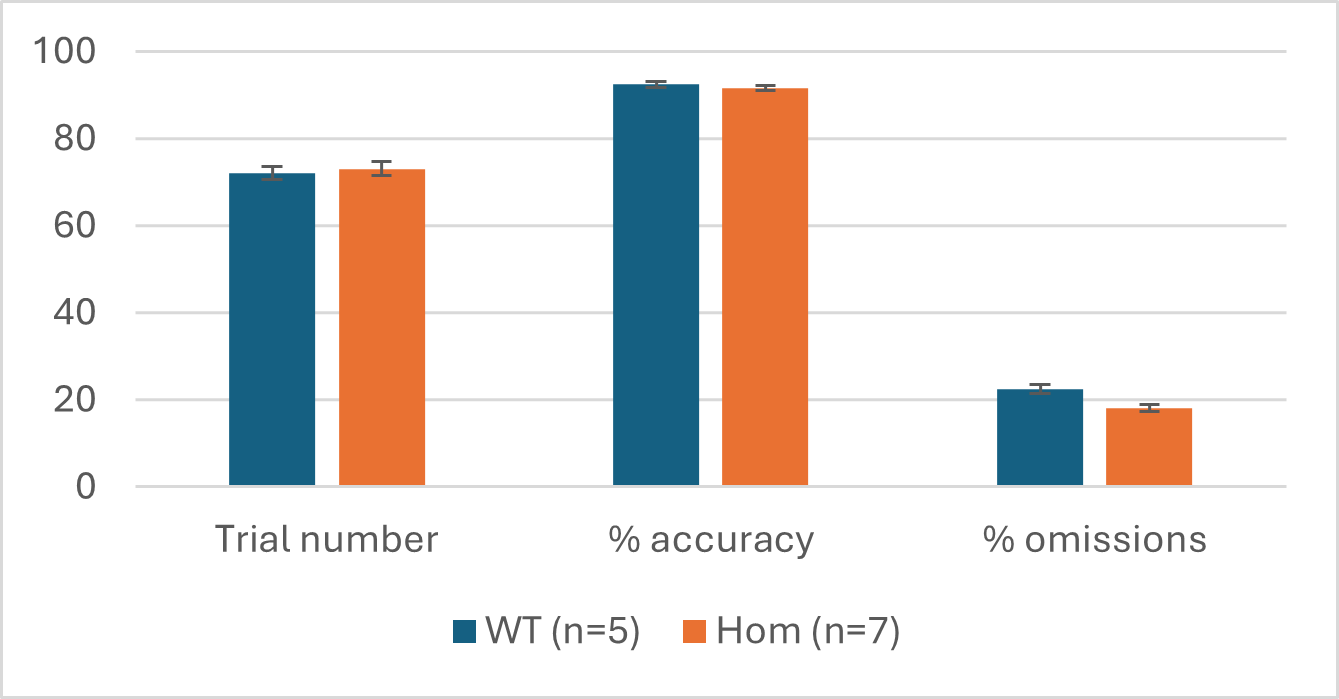
Currently, 12 mice (5 wildtype, 7 STS-deficient mice) have reached baseline performance on 5-CSRTT (1.0s stimulus duration). There was no significant difference in the number of training sessions these mice took to get to this stage: 47.4±0.9 vs. 47.6±4.7 respectively. At baseline, wildtype and STS-deficient mice perform similarly in terms of number of trials undertaken, response accuracy and omissions, as well as in terms of correct response latencies (0.89±0.02s vs. 0.85±0.02s respectively)
Attentional manipulations
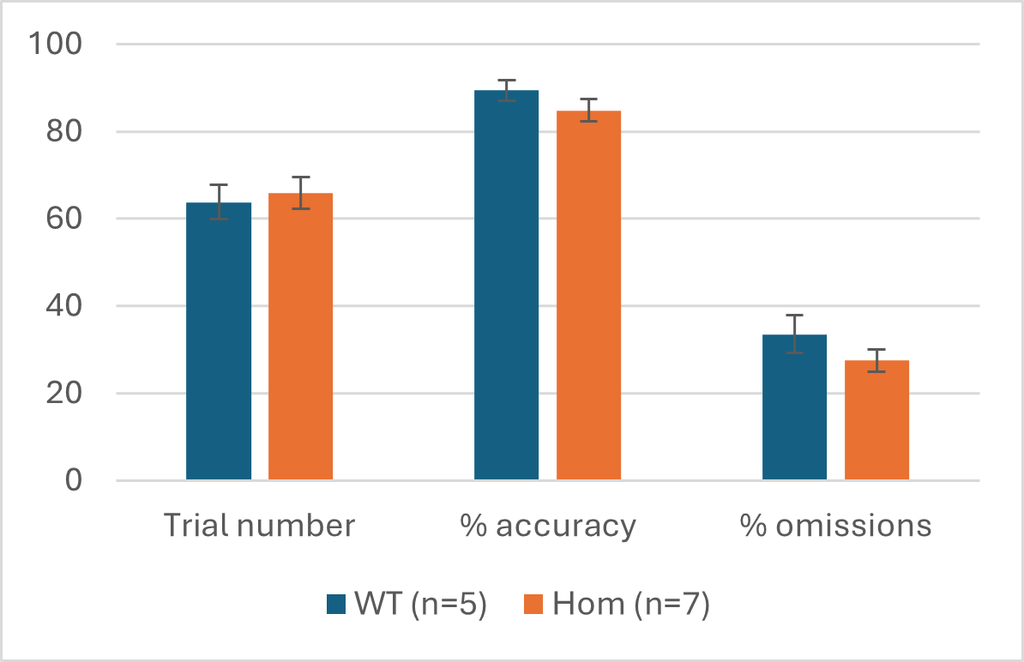
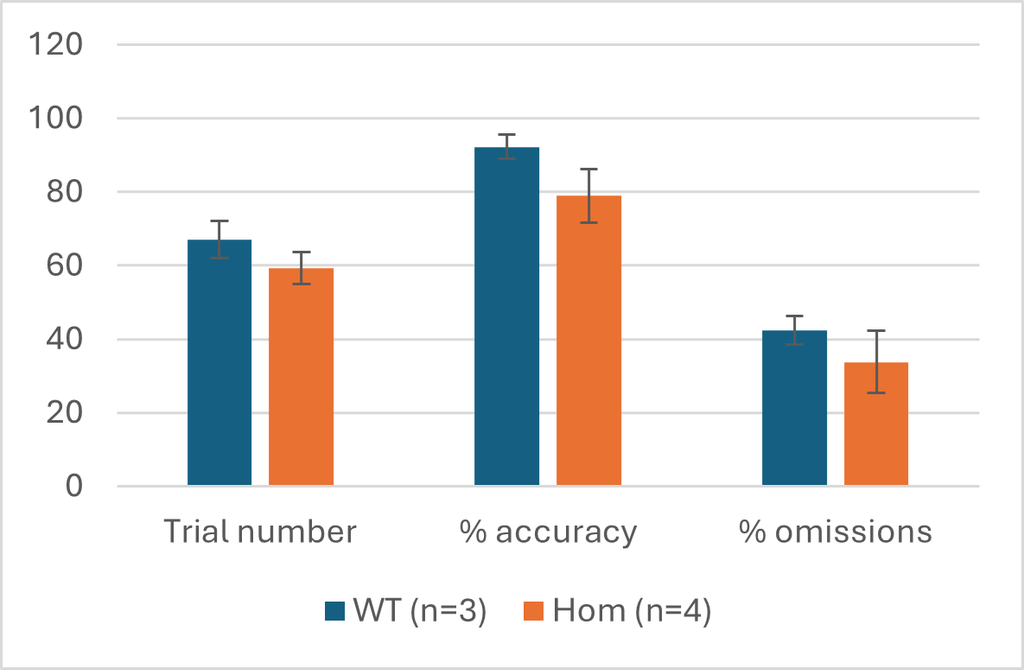
STS-deficient mice show a trend towards reduced response accuracy, fewer omitted responses, and longer correct response latencies (0.85±0.06s vs. 0.81±0.09s) when stimulus duration is reduced (0.2-0.8s, left graph); the effect on accuracy and correct response latency (0.92±0.06s vs. 0.70±0.04s) appears to be magnified when stimulus duration is reduced further (0.1-0.7s, right graph).
Impulsivity manipulations
STS-deficient mice (n=7) show reduced numbers of premature responses relative to wildtype mice (n=5) when the inter-trial interval is moderately extended (5-8s)(6.4±1.7 vs. 9.2±3.2 respectively); however, this pattern is reversed when the inter-trial interval is extended further (5-11s)(20.6±5.8 vs. 11.6±3.5).
Interim conclusions
STS-deficient mice are equivalent to wildtype mice in terms of bodyweight, fluid consumption and milk preference; hence, these factors are unlikely to confound interpretation of the cognitive data. STS-mice perform equivalently to wildtype mice at baseline on 5-CSRTT. As attentional demands of the task are increased, the former group show evidence for lower accuracy and longer correct response latencies, consistent with impaired visuospatial attention. When mice are forced to wait a long time for the stimulus presentation, STS-deficient mice tend to make more premature responses, consistent with greater motor impulsivity. These data are consistent with our previous findings in other STS-deficient mice, and with STS deficiency being causal for increased ADHD risk in STS-sEDD (X-linked ichthyosis).

If you are a physician who treats patients with ichthyosis and you would like to be added to our listing, complete this form.