Building Your Medical Team
It Takes a Village
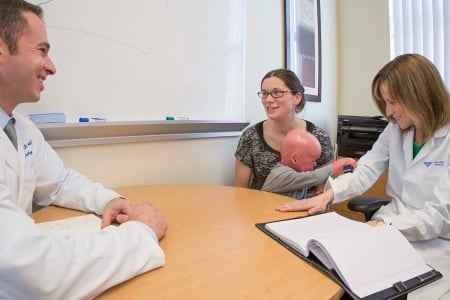
If you have never spent a lot of time with doctors, things are about to change. Since ichthyosis is a rare and complex condition, many different types of specialists will probably be brought in on your baby’s behalf. Although the number of professionals may intimidate you, as you become familiar with each of them and their functions, you will begin seeing them as your baby’s healthcare team. And although it may be, at times, overwhelming, and even a bit confusing, remember, you and your physicians are on the same side; you both want what is best for your child.
It is easy to feel intimidated by doctors. Don’t be! Most doctors appreciate parents who express a willingness to be informed about their child’s condition. Remember that your doctor has other patients and parents, and respect his or her time by organizing and prioritizing your questions. But be assured that you have rights, too.
How can I Prepare for my Visit?
Once you are home and caring for you baby you will likely be communicating with your medical team, through scheduled appointments. At the FIRST National Conference in Indianapolis in 2014 Drs. Keith Choate and Philip Fleckman shared important tips regarding best practices for preparing to meet with an ichthyosis specialist:
- Bring the affected child to the visit only, if possible, and leave the other children at home. This will help with concentration and focus, and ensure that you cover all your areas of concern. The more relaxed you can remain, the more effective the visit will be.
- Discuss the situation with your spouse or other family members who will not be at the doctor visit. Write a list of their questions, as well as your own, and bring it with you.
- Write a summary, journaling what your experience has been since you or your child was diagnosed. Reach out to the doctor before the first visit, by either mailing, emailing or discussing it with them over the phone.
- Send the doctor your questions before the visit so that the doctor can prepare. If you have a genetic diagnosis, share that ahead of time. Even though you are seeing a specialist, he or she may need to research your questions before your appointment.
- It is paramount for them to know the exact genetic diagnosis if you have that information, symptoms, concerns, and specifically how ichthyosis is affecting your lifestyle. Writing it down may also take some of the emotion out of the story, so you can remain focused, and also help the doctor to better prepare for the visit.
- Bring all blood test results, physician reports, photographs, skin biopsy reports and the slides, any paperwork containing the genetic diagnosis, anything that has been medically recorded.
- Always remember there is a difference in what you read on the Internet, and what the average experience might be. Many times the Internet is filled with “worst case scenario” stories. At your visit, discuss the things that you have seen or heard that may be scary or alarming. Your doctor will be able to discern medical fact from hype and sensationalism, and provide more supportive stories, people and resources. Remember there are also a wide range of member stories on the FIRST website, to encourage and support you along the way.
Most importantly, don’t hold back on discussing anything that comes to mind, particularly issues that have made you uncomfortable. This visit is an opportunity to educate yourself and to give yourself peace of mind.
You are your child’s most important advocate. You are entitled to any information you seek. If you don’t understand something your doctor says, ask for a fuller explanation. If you don’t understand why your child is receiving a particular treatment, ask. Don’t be afraid that a question might make you look ignorant and don’t be afraid to speak up! It is vital for you as a parent to feel in control of the wellbeing of your child.
Do I need a diagnosis immediately?
A genetic diagnosis can ensure everyone involved in the child’s care has the most up-to-date and accurate information possible. Sometimes genetic diagnoses change the course of treatment, but most often, care routines are very individualized and fine-tuned over time with the help of the child’s pediatrician and dermatologist.
If you need a genetic diagnosis, FIRST is here to help. Joining the Ichthyosis Registry will allow you to receive a free genetic diagnosis.
If you need a genetic diagnosis, FIRST is here to help. Joining the Ichthyosis Registry will allow you to receive a free genetic diagnosis.